Introduction
Selecting the best ERP system for your organization can be a daunting task. An ideal ERP system has the potential to revolutionize your entire business and not just technology upgrades. From inventory, HR and finance everything, well everything, becomes linked, automated and easier to handle. But with so many choices, it is hard to know which one is right for you.
Choosing the right ERP system for your company can be a challenging endeavor. An effective ERP system can transform your business operations beyond merely updating technology. It connects and automates various functions, including inventory, human resources, and finance, making everything more manageable. However, with a multitude of options available, determining the best fit for your needs can be overwhelming.
In this guide, you will learn how to select the best ERP system for your business in
straightforward, pragmatic and a little bit casual manner so you can confidently choose a
solution that will grow with your business.
Go To Our Official Website – https://www.bridgegroupsolutions.com/
What Does the Mid-Sized Business Need from an ERP System ?
Everything in an organization gets more complicated when a small company expands into a
medium-sized one. You are dealing with bigger teams, bigger inventories, more customers,
and bigger bills than ever before. At this stage, you just cannot hack it with spreadsheets
anymore, or with plain vanilla accounting packages.
A Robust business management systems help you to:
- Reduce the manual effort
- Make better decisions with real-time information
- Avoid errors and double entry of data
- Enhance workflow productivity
- Enhance employee and customer satisfaction
And that is what you get with ERP software or ERP system— a single, integrated system that runs your entire business from one place.
1 .Identify the requirements of your business
Before you start looking at options for ERP software or ERP system, take some time to identify what your
business really needs.
Ask yourself:
What is the largest pain point at the moment? Which processes consume the most time? Where do mistakes occur most frequently? In what areas is communication needed among departments?
For example:
Are you suffering from inventory mis-managment? Is your finance team swamped?
Want more insight into sales? Is the data “layered over different tools?
Once you have somewhat of a wish list, selecting an ERP or ERP system is a lot easier because you know
what you need to look for instead of purchasing a system with features you won’t use.
2. Set a Realistic Budget
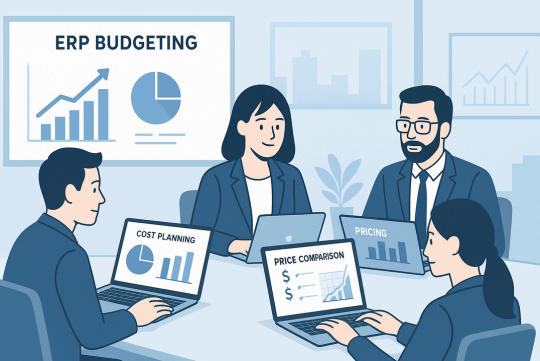
An ERP system implementation is a commitment — not an expenditure — but it still needs a
realistic budget.
Your budget typically comprises:
- Licensing cost (subscription or one-time)
- Customization
- Data migration
- Employee training
- Maintenance and updates
- Many mid-sized businesses opt for the cheapest solutions, only to find out it’s the most
- expensive in the long run. Instead focus on value, and not only price. Best pick the ERP
- software that suits your requirement, grows with your business and saves your cost by
- streamlining your work.
3. Choose the Right Deployment Model – This is one of the most important decisions.
Cloud ERP
- Reduced up-front cost
- Gone are the servers.
- Scalable with ease
- Updates scheduled automatically
- Access from anyplace
Many medium-sized enterprises are turning to cloud ERP or ERP system for lower costs and easier management.
Learn More From – Google.com
On-Premise ERP
- Full ownership of the data
- Perfect for high-security sensitive organisations
- Higher upfront cost
- Requires IT personnel, servers, etc.
- Go for cloud if you want agility and less upfront investment.
Only opt for the on-premise if you have significant IT capabilities and very specific data security requirements.
4. Look for Must-Have Features
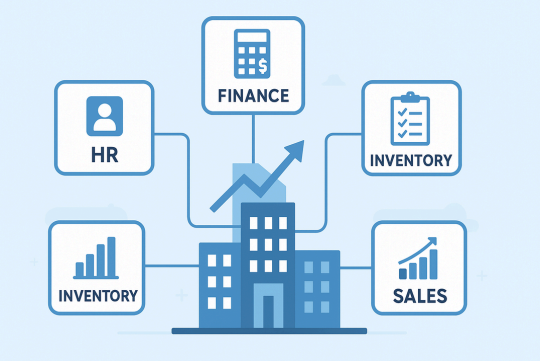
No two ERP systems are the same, but every mid-sized business should expect the basics:
✔ Finance & Accounting
Budget, track billing, invoices, expenses and cash flow in one place. Expenses, budgets,
billing, invoicing and cash flow can all be tracked from the same dashboard.
✔ Inventory Management
Perfect for businesses who warehouse or handle supply chain operations and inventory
management. Perfect for firms with inventory, warehouse or logistics needs.
✔ Sales & CRM
Handles customers, sales pipeline and email. Helps manage customers, communications,
and sales pipelines.
✔ HR & Payroll
Simplifies employee data, attendance, pay, and onboarding. Streamlines attendance,
employee details, payroll and recruitment.
✔Reporting & Analytics
Real-time data enables you to take informed business decisions. Delivers live data making
you able to make smarter decisions.
✔ Integration Ability
Your ERP should allow for seamless integration with the following types of tools:
CRM platforms
E-Commerce Platforms
Payment Processors
HR Apps
✔ Scalability
Select software that can grow with your organization, rather than the one you will outgrow in
a matter of months.
5. Consider ERP Vendors Thoroughly
When Selecting You are not just buying ERP software or ERP system — you are buying into the company
behind that software. A good ERP vendor can help make implementation a breeze, while a
bad one can make it a nightmare.
Check these out before you decide:
⭐ Reputation & Customer Reviews
What do the current users say? Is there any grumbling about bugs, terrible customer
support, or derailed updates?
⭐ Proven in the Industry
Is the provider knowledgeable in your industry?
Is the seller an expert in the industry?
Industry knowledge renders implementation easier.
⭐ Support & Training
Do they have 24/7 support?
Are you going to get trained by them?
⭐ Product Updates
Good ERP vendors will also regularly push updates to increase security and performance.
6. Try out the ERP before you buy it
Don’t buy ERP software without trying it. Almost all vendors offer demos or free trials.
While testing, verify:
Is it easy to navigate the interface?
Workflow: How closely does it align with your workflow?
How speedy is the platform?
Are the reports accurate and can we get to them easily?
Is your team going to be able to make sense of it?
If your staff can’t get the hang of it in the demo, they’re going to have a much harder time
once it’s rolled out. Go with a system that feels intuitive and straightforward.
Best Practices for Seamless ERP Adoption
Once you find the perfect ERP, ensure that the implementation is successful:
✔ INCLUDE KEY TEAM MEMBERS
Input from finance, HR, sales, inventory, and operations.
✔ BUILD A CLEAR ROADMAP
Develop a schedule for:
Data migration
Education
Test
Go live
✔ EDUCATE YOUR PEOPLE PROPERLY
A robust system to manage your business won’t do you any good if you can’t get your people
to actually use it.
✔ Restrict Over-Customization
Rely on the built-in functionality. Too much custom work complicates ERP maintenance.
✔ Think Growth Long Term
Select features and modules that facilitate your strategic path forward, not just your current
hurdles.
Conclusion
Choosing the best ERP for your mid-sized business is not overwhelming in today’s market.
After defining your needs, setting a realistic budget, reviewing deployment options, and
piloting the software, the answer will be obvious.
A good ERP system can be the backbone of your business — improving productivity, reducing
errors, and allowing your employees to work smarter.
It is like going from grinding manually to automatically playing the game.
With the right ERP implementation, your business will be ready to expand, innovate and
succeed for many years to come.
The True Impact of ERP on Mid-Sized Businesses
For many growing companies, implementing an ERP system feels like a massive leap. But in reality, it’s one of the smartest investments a mid-sized business can make. ERP doesn’t just solve today’s problems—it prepares your organization for tomorrow. It acts like the central nervous system of your company, connecting every department so information flows easily and accurately.
Think about how much time is lost every week because teams are chasing data, correcting human errors, searching for approvals, or working with outdated tools. ERP eliminates those inefficiencies entirely. It provides a single version of truth, which means decisions become faster, communication becomes smoother, and operations become more predictable.
When mid-sized companies adopt ERP, they typically see improvements in order accuracy, inventory control, financial reporting, customer service, and internal coordination—all within the first few months.
How ERP Strengthens Decision-Making
One of the biggest advantages of ERP is its ability to transform data into valuable insights. Instead of digging through spreadsheets or relying on assumptions, your team can access real-time dashboards that display KPIs clearly.
With ERP, business owners can:
- Monitor sales performance in real time
- Track inventory levels across multiple warehouses
- Identify cash flow patterns
- Analyze customer behavior
- Forecast revenue accurately
Better decisions come from better data. ERP gives you the data clarity needed to spot opportunities, fix bottlenecks, and guide the company with confidence.
Customization vs. Standardization: Finding the Right Balance
Many mid-sized companies believe their processes are too unique and require heavy customization. But overly customizing an ERP system can lead to complications, higher costs, and maintenance challenges.
A better approach is standardizing processes first, then customizing only where it truly adds value.
Ask these questions:
- Does this customization save us significant time?
- Does it improve customer experience?
- Does it give us a competitive advantage?
- Is it worth the long-term cost?
Most modern ERPs offer flexible modules that can be configured without deep customization, allowing businesses to maintain simplicity while still meeting their needs.
The Importance of Change Management During ERP Deployment
ERP success is not just about software—it’s about people. Even the best system will fail if employees don’t understand how to use it or don’t see the benefit.
Here’s how to ensure smoother adoption:
✔ Communicate early
Let employees know what’s changing, why it’s important, and how it will help them.
✔ Train deeply, not just once
Provide hands-on training, video tutorials, and refresher sessions.
✔ Appoint “ERP champions”
Choose tech-savvy team members to help others during the transition.
✔ Start small and scale
Implement key modules first, ensure users are comfortable, then roll out additional features.
✔ Celebrate improvements
When teams experience real benefits—like time saved or fewer errors—they naturally embrace the system.
Strong change management ensures your ERP or ERP system becomes a valuable tool, not an overwhelming challenge.
Real Examples of ERP Benefits for Mid-Sized Firms
Here are practical scenarios showing how ERP or ERP system makes a difference:
🔹 A trading company
Before ERP: Frequent stockouts, manual inventory counting, delayed shipments
After ERP: Real-time stock visibility, automated reordering, faster fulfillment
🔹 A manufacturing business
Before ERP: Uncertain production schedules, machine downtime
After ERP: Optimized production planning, maintenance alerts, accurate job costing
🔹 A service-based company
Before ERP: Inconsistent billing, scattered client data
After ERP: Centralized CRM, automated invoicing, better resource planning
These examples show that ERP adapts to different industries and solves real operational challenges.
Final Thoughts: ERP Is a Growth Engine
ERP or ERP system isn’t just software—it’s a long-term strategic asset. For mid-sized businesses, it brings structure, efficiency, and clarity at a time when the company is scaling fast. With the right ERP system, you streamline operations, reduce costs, empower employees, and position your business for large-scale growth.
Leave a Reply